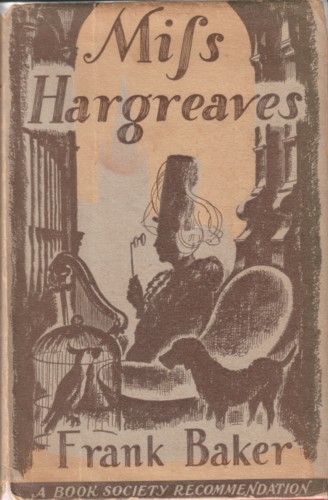
 |
| From Ray Russell's Supernatural Fiction Database |
I discovered this book late last year a few months just after its reissue in paperback from Bloomsbury. I had owned the book for several years and had just decided to find out what it held in store. I must have been picking up on whatever was in the air, for right after I finished reading the book I went looking for info on Frank Baker of whom I knew nothing. Google searches began returning review after review on Miss Hargreaves from blogs all over the US and UK. Apparently the entire world rediscovered this book and its colorful characters at the same time I did. As I often say, "Isn't life filled with amazing coincidences?"
I did find out a few things about Baker – the most surprising being that he has a website devoted to his life and work. Maybe I shouldn't be surprised. These days the internet seems to have a website for everything under the sun. Why not a site for Frank Baker? I'm glad I stumbled across it for I got a bibliography of his work and learned he wrote several enticing books including a dark fantasy that in part inspired Hitchcock's The Birds. And I bet you thought it was solely based on Daphne Du Maurier's novella. Well, I did. And of course now I have a small pile of Frank Baker books that eagerly await reading. But onto Miss Hargreaves…
Norman Huntley and Henry are the best of friends. But they have a habit of indulging in a fantasy game a bit too much. While on vacation in Ireland and touring a dull and gloomy cathedral the two of them invent an elderly poetess friend they dub Miss Hargreaves in order to entertain themselves and befuddle the sexton who is acting as their tour guide. Later they continue to invent and elaborate on the life of Constance Hargreaves who writes doggerel verse, plays the harp, owns a dog named Sarah and a cockatoo named after a character in The Beggar's Opera. Continuing their charade they write a letter to her and send it off to her home (also invented). When they return home Norman is shocked to learn that he has received a telegram from Miss Hargreaves accepting his invitation to visit and that she will be expecting him to greet her at the train station. He and Henry go to the station and are horrified when Miss Hargreaves shows up with cockatoo and dog in tow. Her harp has been previously sent on to Norman's home.
 |
| Young Frank Baker |
Norman's father Cornelius, a scatterbrained bookseller who has a similar habit of embroidering the truth (if not completely fabricating it), warns Norman of the dangers of his wild imagination. He also reminds his son that "Creative thought creates" but Norman turns it around and keeps as his dangerous mantra "Destructive thought destroys." With each attempt at making Miss Hargreaves go away Norman only succeeds in making matters worse. She finds ways to transform and transmogrify herself in order to stay put. Amid all the comedy there are faint echoes of Victor Frankenstein in all of this as Norman's creation gradually begins to turn on him.
This is really rather a remarkable book that has much to say about friendship, father and son relations, and the ultimate power of the imagination. The numerous blog reviews I have read have similar heartfelt, personal reactions and a number of profound insights. Great writing often resonates with human emotion. The impressions sent out through the blogosphere support my belief that Miss Hargreaves is not only noteworthy in the supernatural fantasy genre but also a masterwork in English literature.
"Miss Hargreaves--" I murmured. "Miss Hargreaves--?"
I leant over the rail and looked into the darkness of the Irish Sea. It was night. The lights of our boat were the only lights upon the black water. No answer came from the sea as I mumured that name. And yet, it seemed to me that very faintly in the December air, in the wind, I could hear the sighing of my own name. "Norman-- Norman-- Norman--"

This looks great. I'll try to find it.
ReplyDeleteThis sounds absolutely wonderful. Of course most of the books you review on here do. You're kind of bad for my book-lust problem....... :-)
ReplyDeleteA great review, John. This is such a terrific book. I first heard about it from Simon over at his blog, STUCK IN A BOOK. I absolutely loved it.
ReplyDeleteI reviewed it as well, but I think I like your review a bit better. :)
Is that the ending you revel at the end of the review, John? I hope not, and yet it so seems it could be. I'll look for this one.
ReplyDeleteRichard -
ReplyDeleteNo, it's from the prologue to the book. It's the opening paragraph, in fact, and sets the whole tone of the book. When I read it I suspected foreshadowing of a bittersweet ending. I'll say no more.
Danged if you don't make it sound interesting, despite the title.
ReplyDeleteDavid here
ReplyDeleteThanks for this one. It's even more of a must learning that the stage version starred the incomparable Margaret Rutherford in the title role.
I'll have to look up his dystopian novel THE BIRDS too and that first Lawrentian novel about a Jack the Ripper type killer.
Hi there,
ReplyDeleteI thought I recognised that particular copy of the first edition of "Miss Hargreaves" on your blog... One of the reasons I set up the Supernatural Fiction database from which you took the image (http://tartaruspress.com/b2.htm) was to publicise the book, which is one of my all time favourites. I even published an edition of it (http://tartaruspress.com/hargreaves.htm)
Anyhow, I thought I'd recommend as further reading Margaret Rutherford's collection of Edward Lear's poetry, "How Pleasant to Know Mr Lear". Frank Baker writes the Introduction and gives quotations from the poety of Miss Hargreaves. In the novel she reads from her own poem:
"Cleft in the narrow gulf of gusty grief..."
But in the Lear collection Baker gives us her second line:
"My soul is like a cricket on a leaf."
It's worth acquiring the book for that line alone :-)
Ray -
ReplyDeleteIt was careless of me not to give credit for the photo. I have amended the post.
My favourite book! And you might even see my name on the back of it :) I was so thrilled when Bloomsbury published it.
ReplyDeleteGreat review, which I'm coming to horribly late. Did you end up reading any other Baker books?
Hello again, Simon! Sorry to tell you that both of my copies are vintage 1940 editions and your name is nowhere in sight. I owned a cheap 1940s reprint of Miss Hargreaves for years, long before the reprint edition from Bloomsbury was released. A book that I understand you had a hand in making possible. Thank you for bringing Constance back to hundreds of happy readers! Later I purchased two fine 1st editions (one a US edition with DJ, the other a UK without) because I love the book so much.
DeleteAlso, you're not coming to this post all that late. You read this review three years ago and posted about it on your own blog (Weekend Miscellany: Nov 19, 2011). You even included a link to my post. Short term memory loss at such a young age already? ;^)
I have only read The Birds by Frank Baker (recently reissued by Valancourt Books) and thought it very strange but wonderful. Eerie and sinister and sometimes rather funny -- so unlike the Hitchcock movie it supposedly inspired. And so very different from Miss Hargreaves, a considerably more lighthearted book. I own two of his other fantasies (Mr. Allenby Loses His Way and Sweet Chariot), but have yet to read them. The one book by Baker I am very eager to find and read is his thriller The Twisted Tree, but it's so scarce as to be a legitimately rare book. I doubt I will ever find a copy let alone find one I can afford should one ever turn up.
That's hilarious! I actually was pretty sure I'd read your review, and thought I'd commented, but couldn't see a comment from me and so thought I'd not mentioned it... or that I was going mad... I'm glad that that isn't the case! :D
Delete(Although I have read old posts on my own blog and had no recollection of writing them...)
Should I admit that I own The Twisted Tree and have yet to read it? I've read Mr Allenby Loses His Way, Before I Go Hence, Stories of the Strange and Sinister, and Teresa, and none have lived up to Miss H - but I will persevere.
How wonderful to discover this discussion, albeit a little late! Frank Baker was staying with my grandmother back in the 1950s when I, as a small child, met him. I loved Miss Hargreaves when it came out (he sent a copy to my grandmother) and could never forget its plot. Once read, never forgotten, that one.
ReplyDeleteAnd did you know of Miss Hargreaves book of poems? A Wayside Bundle? Thereby hangs another story... I have a copy of that rare text too.
I had no idea Baker wrote a book of poems and pretended that Miss Hargreaves wrote them. That's hysterical! I went looking for a copy and surprisingly found quite a few of them for sale. But not one mention of Frank Baker or his fantasy novel in any of the sales catalog descriptions! Anyway I thought they were all very reasonably priced and bought the best of the lot immediately. Thanks you for stopping by, Jo, and letting us all know about Wayside Bundle. Looking forward to getting my copy which will have a special place next to my two first editions of Miss Hargreaves.
Delete