
Yves Jacquemard and Jean-Michel Sénécal are two actors and playwrights who collaborated on over twenty plays for the French stage. They also wrote a handful of mystery novels - two of which were translated into English. Their second mystery novel is inspired by one of the Christie books adapted for the stage -- Ten Little Indians or, as it is known in the US edition, And Then There Were None.
The idea is an intriguing one. A French director writes his own adaptation of the Christie novel sticking to the grisly and depressing ending and not the relatively happy ending of the stage and later movie versions. He also adds expressionistic make-up (of his own design) and other late 1970s style theatrical gimmicks in his new version of the Christie standard. We are introduced to the entire cast of the play, the director, the theater owner and other employees of the theater in a quick four chapters in which some deep, dark secrets are hinted at, petty jealousies are revealed, and volatile emotions expressed. Then in Chapter 5 ("The Day of the Tragedy") the entire cast of the play - save one actor - is discovered murdered, the custom make-up that all the actors wear has been poisoned. Adding to the mystery is one unknown dead man found in the dressing room of the lone survivor. The tabloid newspapers dub this mystery corpse "the eleventh little Indian." In a typically ironic twist the survivor of the cast, and the one who discovers the bodies of his fellow cast members, is the actor who is playing the judge.
One caveat, however. Unless you are familiar with And Then There Were None you probably should not read this book. At one point in the story the theater director mentions a character and identifies it as the killer in the play they are working on.
But for those many of us who already know the source material whether it be the novel, the movie, or play version, this is a highly enjoyable homage to the traditional whodunit and Agatha's works. Should you have a deeper knowledge of the Christie canon than just the one book you will enjoy it even more. There are many allusions to other Christie novels. I spotted references to Murder on the Orient Express, The Murder of Roger Ackroyd, Mrs. McGinty's Dead, Peril at End House, The Mousetrap, and Witness for the Prosecution. For this first time in a long time I can enthusiastically recommend this book for all Christie aficionados and for anyone who loves a good old-fashioned style detective novel.
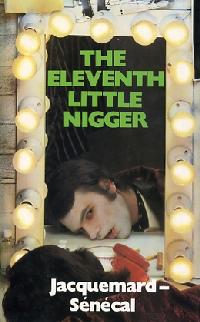
NOTE: As can be seen in the book scans I used to illustrate this post, the French and British editions of this book use the original forbidden word in the title. The US version substitutes the word "Indian" as was done for the 1965 movie of Christie's novel and all subsequent versions.

Le crime de la Maison Grün, 1976 (winner of Prix du Quai des Orfèvres 1977)
translated into English as The Body Vanishes (1980)
features their police detective Lancelot Dullac
Le Onzième Petit Nègre, 1977
translated into English as The Eleventh Little Indian (1979)
Meurtre dans les corons, 1978
L'enigme du Puits D'Enfer, 1979
with Dullac
Qui a tué Scarlett O'Hara?, 1981
with Dullac
Un crime en Lorraine ou "Corbeau ascendant Vierge", 1991
with Dullac

Wow, This does seem worth hunting down.
ReplyDeleteMy thoughts exactly. This really sounds like a splendid, splendid idea! Good thing it turns out I'm going to be in Paris for a day. Does this call for a bookstore raid en français? I think so! ;)
ReplyDeleteAlthough, odds are I won't find it. Still, one can always dream...
Patrick - You should be able to find it closer to home with no problem. There are several copies of the English translation available through the usual internet bookselling sites. All of them are very affordable, but most seem to be ex-library copies. I'd be surprised if it wasn't in an Ontario library near you. It was a big hit when it was first published.
ReplyDeleteA very long time since I read this one, and I can't recall it in detail, but I did like it.
ReplyDeleteI dunno, John. I always prefer reading stuff in its original language when I can. If worst comes to worst, I'll just place an ILL for the translation, but I'll try finding the French version first.
ReplyDeleteStraight on to my wishlist.
ReplyDeleteI believe both the American and the British versions of Christie's novel is And Then There Were None. Ten Little Indians is the name of the play and an alternate title for the book.
ReplyDeleteIncorrect. The original title of Christie's book is Ten Little Niggers. Click here to see the 1st edition dust jacket for proof. The title was changed to Ten Little Indians in subsequent UK editions to remove the offensive perjorative. And Then There Were None is the alternate title Dodd Mead created and they changed "niggers" to "Indians" throughout the book to make it more palatable (and sellable!) for American readers. The same alternate title was then used by the movie producers.
DeleteAs for your other comment (which I choose not to publish) I do not think that sentence is a spoiler for those unfamiliar with Christie's book and I am not going to change it.
I do not question that the original title of the 1939 book is Ten Little N------. But the title of the book in America has always been And Then There Were None, and since the 1980's that title has also been And Then There Were None in Great Britain. According to Wikipedia, the last book published under the title Ten Little Indians was 1986. The title And Then There Were None isn't new and is just as legitimate as Ten Little Indians.
DeleteSince the British editions of this book kept the original title as late as the 1980's, I don't think it was changed in Britain to sell more American books, but because the title Ten Little N------ was now offensive to British. Of course, since 2007 the book has now replaced "Indians" with "soldiers", and the instances in the book where a character used to say "There's a n----- in the woodpile" have been excised.
One of these days, I'd like to read an annotated edition that includes the changes made in the novel since 1939.
Never mind the stupid arguments about the title. I am perfectly willing to concede that you are right and I am wrong. What should matter is that this book---no matter how you call it---is a great mystery worthy of Agatha Christie. I think the English translation could be improved, but what I read so far does not change my opinion of the book. I am very grateful to Patrick of "At The Scene of the Crime" for getting me to read this.
ReplyDeleteIt's also a shame that only one other book by Jacquemard-Sénécal has been translated into English (The Body Vanishes) because I would love to read Qui a tué Scarlett O'Hara? or Who Killed Scarlett O'Hara. This is a sequel to The Eleventh LIttle Indian because the person who solved that mystery in that book also is the detective in this book.
DeleteYou have referred to several Agatha Christie novels.
ReplyDeleteA part of the solution (why so many murders ?) is also based on a famous novel by Agatha Christie !